Q. Which of the following statement is correct?
S1: (diag[X, Y, Z])-1 = diag [1/X, 1/Y, 1/Z] |
S2: Eigen value of diag[X, Y, Z] = X, Y, Z |
S3: Determinant of diag[X, Y, Z] = |diag[X, Y, Z]| = XY+YZ+ZX |
Here diag[X, Y, Z ] is a diagonal matrix whose diagonal elements are X, Y and Z.
Q. Which of the following matrices is not an idempotent matrix?
Q. Consider a matrix B is a skew-symmetric matrix. Then B.B is a __________?
Q. Let A5x7, B5x7 and C4x7, be three different matrices. Then the order of (C(ATB)-1CT)T is __________.
Q. Let A and B be two square matrices of order N x N. Which of the following statement is correct?
S1: tr(A+B) = tr(A) + tr(B) |
S2: tr(AB) ≠ tr(BA) |
S3: If the value of the tr(A) = 5 then the value of tr(A3) = 125 |
Q. The inverse of the matrix of order 2x2
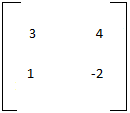
is:
Q. The Eigen value of the matrix
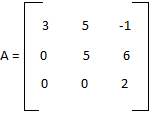
Q. The Eigen values of a skew-symmetric matrices are?
Q. The Eigen value of the 2 x 2 matrix
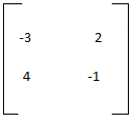
are __________?
Q. Let
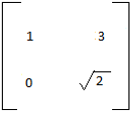
be a matrix then the Eigen values of
A9 will be?
Q. Consider for a matrix A =
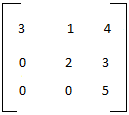
,
X = trace of
A and
Y = determinant of
A. Then the value of
(X2 + Y2) will be __________.
Q. Let A3x3 and B3x3 are two matrices then the product of matrix B-1(AB-1)-1A will be?
Q. Let A =
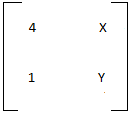
be a matrix whose eigen values are
3 and
5. The value of
X2+XY will be,
Q. Given that the determinant of the matrix
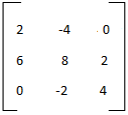
is 168. Then the determinant of the matrix
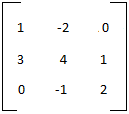
will be?